
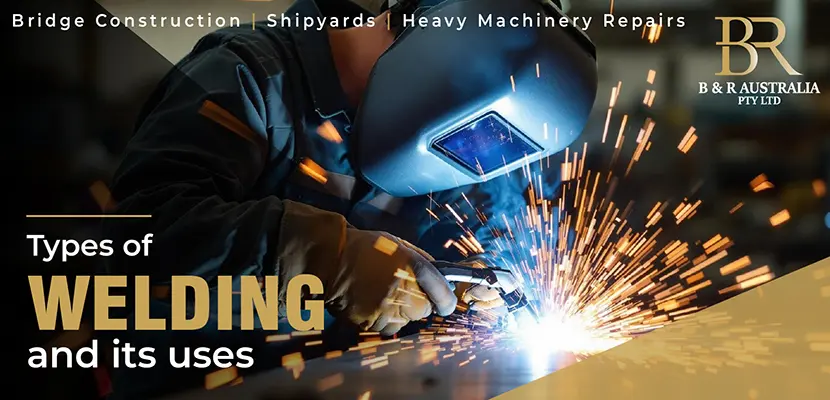
Types of welding and its uses come up in almost every metal-based job, whether it’s building structures, fixing machinery, laying pipelines, or working on fabrication projects. Welding is basically how metal parts are joined so they can take load, pressure, and long-term wear without breaking apart.
In real work, nobody just “does welding”. The choice depends on site conditions, metal type, and what the job actually demands. Some jobs need speed, some need precision, and some need pure strength. Along with welding, cutting and shaping metal is just as important, because poor preparation always leads to weak joints later.
What Welding Actually Means in Simple Terms
Welding is the process of joining two metal pieces using heat or pressure so they become one solid piece. When done properly, the joint is as strong as the base material.
When people search for types of welding, they’re usually trying to understand which process is used where—and why different jobs need different techniques.
Main Welding Types Used in Industry
Stick Welding (SMAW)
Stick welding is one of the most commonly used methods on site work. It’s simple, strong, and doesn’t depend too much on controlled environments.
Where it is used:
- Steel structures and fabrication
- Pipeline work
- Outdoor repair and maintenance jobs
It handles rough conditions well—dust, wind, and rust don’t affect it as much. That’s why field teams, including contractors like B & R Australia, still rely on it for structural work.
MIG Welding
MIG welding is more common in workshops and production setups. It runs continuously, so work moves faster compared to stick welding.
Where it is used:
- Vehicle repair shops
- Light fabrication work
- Manufacturing units
It gives cleaner welds, and once the settings are right, it becomes easier to maintain consistency across multiple pieces.
TIG Welding
TIG welding is slow but very controlled. This is the method used when the finish has to look clean and precise.
Where it is used:
- Stainless steel work
- Aerospace components
- Fine fabrication and detailed metal work
It’s not the fastest method, but the level of control makes it the go-to choice for precision jobs.
Flux-Cored Welding
Flux-cored welding is built for heavy-duty work. It performs well even when conditions are not perfect.
Where it is used:
- Bridge construction
- Shipyards
- Heavy machinery repairs
It’s often chosen when the job needs deep penetration and strong bonding on thick materials.
How Many Types of Welding Are Actually Used?
If you go by engineering standards, there are more than 30 welding processes in total. But in day-to-day industrial work, only a few are actually used regularly.
So when people ask how many types of welding, the practical answer is simple: four main ones handle most jobs—Stick, MIG, TIG, and Flux-Cored welding.
Welding Types in Real Work Conditions
Different jobs need different approaches. In the field, it usually looks like this:
- Construction teams use stick welding for strength
- Workshops prefer MIG for speed and repeat work
- Precision industries depend on TIG for clean output
- Heavy infrastructure work uses flux-cored for deep bonding
That’s why understanding welding types matters more than just knowing definitions—it directly affects how strong and reliable the final structure will be.
Role of Metal Cutting Before Welding
Before anything is welded, metal has to be cut and shaped properly. This step is just as important as welding itself.
This is where Types Of Metal Cutting Machine Tools come in.
Common tools used in fabrication work:
- CNC cutting machines for accurate sizing
- Plasma cutters for thick steel sections
- Laser cutting for clean, precise edges
- Grinding tools for finishing and alignment
If cutting is not accurate, welding becomes harder and weak points start showing later in the structure.
How Welding and Cutting Work Together
In real fabrication work, welding never happens alone. It follows a proper flow:
- First, metal is measured and cut
- Then pieces are aligned and fixed in place
- After that, welding is done using the right method
- Finally, finishing and inspection are done
Contractors like B & R Australia follow this exact workflow for structural jobs so the final output holds up under load and time.
Choosing the Right Welding Method
There is no “best” welding method. It depends on the job.
Key things that decide the method:
- Type of metal (steel, stainless, aluminum)
- Thickness of material
- Indoor or outdoor work
- Strength required
- Speed of execution
Understanding types of welding and its uses helps avoid trial-and-error on site, which can waste time and material.
FAQs
1. What are the main types of welding used in industry?
Stick, MIG, TIG, and Flux-Cored welding.
2. Which welding method is most common on site work?
Stick welding is widely used for outdoor and structural work.
3. Which welding is used for clean finishing?
TIG welding is used where appearance and precision matter.
4. Why is metal cutting important before welding?
Because accurate cutting ensures proper fitting and stronger joints.
5. Which welding is used for heavy structures?
Flux-cored welding and stick welding are commonly used for heavy-duty work.