
Quick Answer
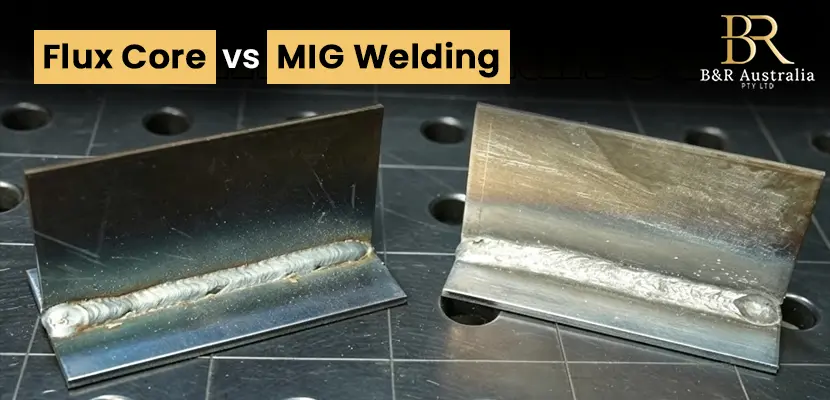
The main difference between flux core vs MIG welding is how each process protects the weld. Flux core welding uses flux-filled wire, while MIG welding uses solid wire with external shielding gas. Flux core works well for outdoor repairs and thicker steel. MIG produces cleaner welds and suits indoor fabrication, thin metal and projects requiring a smooth finish.
Key Facts
- Welding Process: MIG uses solid wire and shielding gas, while flux core uses tubular wire containing flux.
- Weld Strength: Both produce strong welds when welders select the correct wire, settings and joint preparation.
- Welding Cost: Flux core wire generally costs more, but self-shielded wire eliminates external gas expenses.
- Best Applications: Flux core suits outdoor steelwork, while MIG works well for indoor fabrication and thinner metals.
Flux Core vs MIG Welding: Which Process Offers Better Strength, Cost and Performance?
Choosing between flux core and MIG welding depends on metal thickness, working conditions and the required finish. Both processes use continuously fed wire, but their performance differs.
Fabricators often use MIG for workshop projects requiring accurate, clean welds. Flux core suits demanding jobs where outdoor conditions, welding position and thicker materials affect productivity.
Understanding these differences helps businesses choose suitable welding methods for repairs, fabrication and construction.
How Does Flux Core Welding Work?
Flux cored arc welding (FCAW) uses a hollow wire electrode filled with flux compounds. Heat from the electric arc melts the wire and joins metal surfaces.
Two common types include:
- Self-shielded flux core: Produces protective gases from the flux without external shielding gas.
- Gas-shielded flux core: Uses additional shielding gas and commonly supports heavy fabrication work.
Flux core welding works well for structural steel welding, equipment repairs and outdoor construction. However, welders must remove slag between passes and after welding.
How Does MIG Welding Work?
MIG welding, also called Gas Metal Arc Welding (GMAW), feeds solid wire through a welding gun. Shielding gas protects the molten metal from atmospheric contamination.
The process produces relatively clean welds with little slag. Welders commonly use it for metal fabrication, automotive repairs and workshop manufacturing.
MIG welding also allows good control when joining thinner materials. However, wind can disturb the shielding gas, making outdoor welding more difficult without protection.
Which Is Stronger: Flux Core or MIG Welding?
Both welding methods can produce reliable, strong joints. Weld strength depends on electrode classification, penetration, welding technique and material preparation.
Flux core welding often offers high deposition rates and good penetration on thicker steel. This makes it useful for heavy structural applications.
MIG welding can also achieve excellent joint strength when operators use suitable equipment and settings.
For load-bearing structures, welders must follow approved welding procedures and applicable standards rather than choosing a process based on strength claims alone.
Which Welding Process Costs Less?
MIG welding generally uses less expensive solid wire, but requires shielding gas, regulators and cylinders.
Self-shielded flux core welding removes gas cylinder expenses, although its wire usually costs more.
Other expenses include:
- Equipment purchase and maintenance
- Welding wire consumption
- Gas supply and transport
- Labour and surface preparation
- Slag removal and finishing
For small outdoor repairs, self-shielded flux core can reduce setup costs. In workshop production, MIG may offer better value through cleaner welds and reduced finishing work.
Which Welding Method Works Best for Different Applications?
Flux core welding suits:
- Outdoor structural steel welding
- Heavy equipment and machinery repairs
- Mobile welding at construction sites
- Industrial maintenance and steel repairs
MIG welding suits:
- Indoor metal fabrication
- Automotive panels and components
- General material welding
- Workshop steel fabrication
Neither method replaces every other welding process. For example, TIG welding may suit precision work, while stick welding remains useful for certain outdoor repairs.
The correct choice depends on access, material condition, joint design and project requirements.
Can Flux Core and MIG Welding Handle Rusty or Dirty Metal?
Flux core welding generally tolerates minor surface contamination better than solid-wire MIG welding. Its flux ingredients help manage certain impurities during welding.
However, neither method should be used as an excuse to weld heavily rusted, painted or contaminated steel without proper preparation.
Cleaning the joint improves fusion and reduces defects. Workers should also remove hazardous coatings and follow suitable ventilation and fume-control procedures.
How Do You Choose the Right Welding Process for Your Project?
Start by checking metal thickness, working location, joint requirements and available equipment.
MIG welding often makes sense when appearance and finishing time matter. Flux core becomes useful when welders need higher deposition rates or work outdoors.
For industrial projects, experienced welding teams should assess material specifications and inspection requirements before beginning work.
B & R Australia Pty Ltd provides welding and fabrication services for industrial and commercial requirements. Choosing the appropriate process helps achieve dependable repairs, suitable weld quality and efficient project completion.
Frequently Asked Questions
1. Is flux core welding better than MIG welding?
Flux core suits outdoor work and thicker steel, while MIG works well for clean indoor fabrication.
2. Which welding process produces stronger welds?
Both can produce strong welds. Strength depends on materials, electrode selection, settings and welding technique.
3. Is flux core welding cheaper than MIG?
Self-shielded flux core saves gas costs, but its wire generally costs more than MIG wire.
4. Can beginners use flux core welding?
Yes. Beginners can learn flux core welding, although managing slag, spatter and settings requires practice.
5. Is MIG welding suitable for outdoor work?
Yes, but welders must protect the shielding gas from wind to prevent weld defects.