
Quick Answer
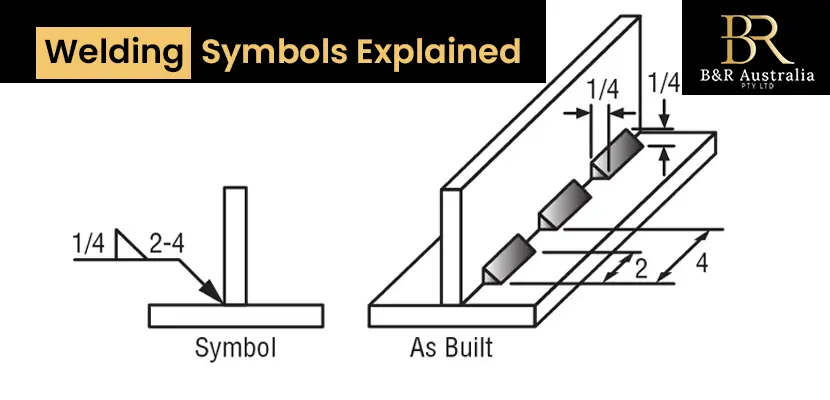
Welding symbols are signs used on engineering drawings to tell welders where to weld, which joint to make, and what size the weld should be. They show details such as weld length, position, shape, and finishing requirements. Reading these symbols correctly helps welders follow the drawing and avoid mistakes during fabrication.
Key Facts
Purpose: Welding symbols show weld types, sizes, positions, and joint requirements.
Main Parts: Arrow, reference line, weld symbol, dimensions, and optional tail.
Common Symbols: Fillet weld, groove weld, plug weld, spot weld, and seam weld.
Standards: AS 1101.3, ISO 2553, and AWS A2.4 explain welding drawing symbols.
Welding Symbols Explained: Complete Chart and How to Read Welding Drawings Without Confusion?
A welding drawing may look complicated when you first see it. Lines, arrows, triangles, and numbers appear around different parts of the metal. Each mark tells the welder something about the work.
For example, a triangle normally indicates a fillet weld, while a V-shaped mark shows a groove weld. Numbers beside these marks give measurements.
Workers involved in Metal Fabrication and Structural Steel Welding use these drawings to prepare joints, select welding methods, and check completed work.
What Are the Common Welding Symbols and Their Meanings?
Different joints need different welds. The chart below explains the welding symbols commonly found on fabrication drawings.
| Welding Symbol | Shape | Meaning |
|---|---|---|
| Fillet Weld | Triangle | Welds two surfaces meeting at an angle |
| Square Groove Weld | Two parallel lines | Joins metal edges without groove preparation |
| V-Groove Weld | V shape | Requires V-shaped joint preparation |
| Bevel Groove Weld | Sloping and straight lines | Requires one bevelled edge |
| U-Groove Weld | U shape | Uses curved edges for welding |
| J-Groove Weld | J shape | Uses one curved prepared edge |
| Plug Weld | Rectangle | Joins overlapping plates through a hole |
| Slot Weld | Rectangle | Joins plates through an elongated opening |
| Spot Weld | Circle | Makes welds at individual points |
| Seam Weld | Seam symbol | Joins material along a seam |
These shapes are descriptions, not exact drawing symbols. Always check the standard mentioned on the drawing.
How Can You Read Welding Symbols Step by Step?
Start by finding the arrow pointing towards the joint. Then look at the reference line attached to it.
Follow these steps:
- Find the arrow: Check which joint needs welding.
- Identify the symbol: Look for a triangle, V, square groove, or another weld mark.
- Read the measurements: Check weld size, length, and spacing.
- Check the location: Find out which side needs welding.
- Read additional notes: Look for welding procedures or finishing instructions.
Suppose a drawing shows a 6 mm fillet weld. The welder must check the symbol, specified measurement, and weld location before starting.
What Do Welding Symbols Above and Below the Line Mean?
Symbol placement tells the welder which side of the joint needs attention.
Under AWS A2.4 and ISO 2553 System B:
- Below the reference line: Weld on the arrow side.
- Above the reference line: Weld on the opposite side.
- Symbols on both sides: Weld both sides as shown.
ISO 2553 System A uses continuous and dashed reference lines instead. Check the drawing standard before interpreting the position.
How Are Welding Symbols Used in MIG, TIG, and Stick Welding?
Welding symbols describe the required weld, but the drawing or welding procedure determines the welding process.
MIG Welding works well for many steel fabrication jobs, including frames, brackets, and workshop components.
TIG Welding is commonly used for stainless steel, aluminium, and joints needing careful heat control.
Stick Welding is often used for heavy steel repairs, outdoor work, and site maintenance.
The material, joint design, and welding procedure help determine the correct method.
Why Do Welding Symbols Matter in Metal Fabrication and Structural Steel Welding?
Incorrect weld measurements can cause fitting problems, extra grinding, or rejected work.
During Structural Steel Welding, workers check joint preparation, weld size, and inspection details before joining beams, columns, and plates.
For Aluminium Fabrication, drawings help identify joint requirements before workers begin welding thinner or heat-sensitive components.
Welding symbols also help workshop teams follow the same instructions when several welders work on one project.
What Mistakes Should Welders Avoid When Reading Welding Drawings?
Misreading a small symbol can mean cutting out a weld and doing the job again.
Common mistakes include:
- Welding the wrong side of a joint.
- Ignoring weld length and spacing.
- Confusing fillet welds with groove welds.
- Missing finishing instructions.
- Using the wrong drawing standard.
Checking unclear details with the supervisor or drawing designer before welding can prevent unnecessary repairs.
How Do Welding Symbols Help With Mobile Welding and Repair Work?
During Mobile Welding, workers may need to repair broken brackets, machinery parts, or damaged steel connections.
Drawings help them locate the repair and understand the required joint.
Some jobs also involve Air Arc Gouging to remove damaged weld metal before replacement welding begins.
For fabrication and industrial welding work, B & R Australia Pty Ltd provides welding and metal fabrication services, including on-site repair and maintenance.
Frequently Asked Questions
What are the basic welding symbols?
Fillet, groove, plug, slot, spot, and seam weld symbols are commonly used.
What does a triangle mean in welding?
A triangle represents a fillet weld, often used on T-joints and lap joints.
How do you read a welding drawing?
Check the arrow, weld symbol, measurements, joint location, and drawing notes.
What does a circle mean in welding symbols?
A circle at the arrow junction means weld all around. A separate circle may indicate spot welding.